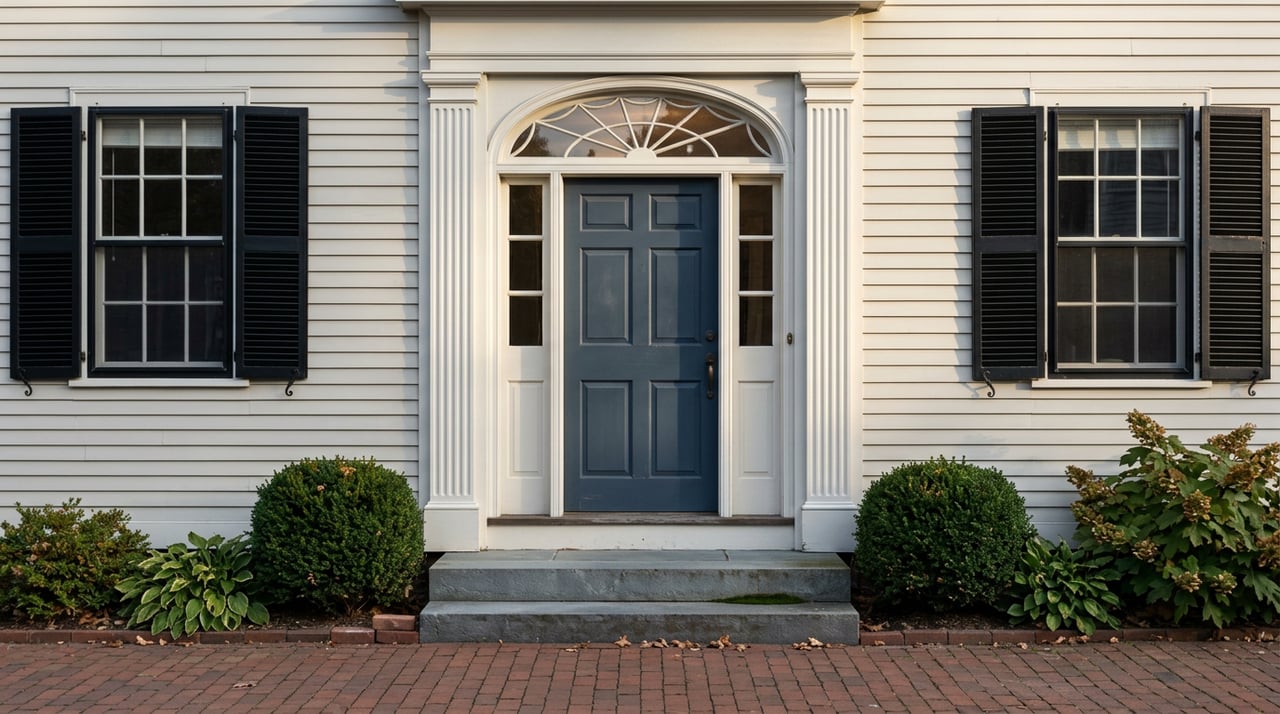
The application that nominated Cranbury to the National Register of Historic Places in 1980 did not hedge its language.
"Cranbury is the best preserved 19th century village in Middlesex County... While there are many small mill towns in New Jersey, few are in such an undisturbed environment as that of Cranbury."
That sentence is why the village still looks the way it does. It is also why two nearly identical Main Street houses, sold roughly nine weeks apart across the end of 2025 and the start of 2026, closed at prices that shouldn't make sense side by side unless you understand what actually governs a renovation timeline inside a historic district.
Two Houses, Same Street, Different Clocks
Start with the numbers, because they are the whole argument.
Address | Built | Sold | Sale Price | Price/Sq Ft | Days on Market |
|---|---|---|---|---|---|
59 S. Main St. | 1836 | Nov. 25, 2025 | $1,410,000 | $401 | 80 |
75 N. Main St. | 1880 | Jan. 29, 2026 | $565,000 | $313 | 199 |
Both are pre-Civil War or Victorian-era homes inside Cranbury's National Register district, which Wikipedia describes as extending along Main Street. Both sit on Main Street, a few blocks apart. One sold in under three months at $401 a square foot. The other sat for nearly seven months and closed at $313 a square foot, roughly 22 percent below the first home's per-square-foot price.
A buyer comparing these two on a portal would see square footage, bedroom count, and lot size and might reasonably wonder why the market treated them so differently. Size and condition explain part of the gap. But the piece that doesn't show up in either listing is the approval calendar sitting underneath any exterior work a new owner might want to do, and that calendar is not the same for every buyer walking into the same house.
How the Approval Clock Actually Runs
Cranbury's historic district covers 175 acres and includes 177 contributing buildings, stretching along Main and Prospect Streets, Maplewood and Scott Avenues, Bunker Hill Road, Symmes Court, and Westminster, Park, and Wesley Places. It was added to the National Register on September 18, 1980, and the township's Historic Preservation Commission has governed exterior changes inside that boundary ever since.
The mechanics matter more than the history here. According to Cranbury Township, the process works like this:
- Some exterior work on a property inside the designated historic district requires a Certificate of Approval before work begins.
- The Historic Preservation Commission meets twice a month, on the first and third Tuesday, starting at 7 p.m.
- A complete application must be received at least 10 days before a scheduled meeting to land on that meeting's agenda.
- There is no fee to file.
- Painting alone does not trigger review. Replacing deteriorated siding, trim, windows, or other exterior elements generally does.
Run that math on a real timeline. A buyer who closes on a house needing new windows or a rebuilt porch cannot simply hire a contractor and start Monday morning. They need a complete application filed with enough lead time to catch one of two monthly meetings.
That is not a cost the seller pays. It is a cost the buyer inherits the moment they close, and it shows up as carrying costs, delayed move-in, or a summer spent living around a project that hasn't started yet.
Where the District Actually Starts and Stops
This is worth checking address by address, because the boundary is specific rather than townwide. A house on Station Road or Broadway Road can be just as old as one on North Main Street. Two houses can look like twins from the street and carry completely different renovation timelines depending on which side of a line they sit on.
Anyone comparing an older Cranbury home to a similarly priced property elsewhere in Mercer or Middlesex County should ask, plainly, whether the address falls inside the designated district before assuming the same math applies.
What the Median Price Hides
Zoom out to the broader market and a version of the same pattern shows up in the aggregate numbers. As of June 2026, homes listed for sale in Cranbury carried a median list price near $1.17 million and a median of $392 per square foot, with a typical listing spending about 49 days on market. Looking at the 12 months of closed sales ending in early 2026, the median sale price across all Cranbury transactions ran closer to $922,000, up about 4 percent year over year, with roughly 82 homes changing hands and an average time on market nearer 42 days.
That gap between what sellers are asking now and what has actually closed over the past year is wider than you'd expect in a market moving in under two months. Part of that gap is simple mix. Newer construction, including recent Toll Brothers product in the Regency at Cranbury community, tends to move fast and price cleanly because there is no approval clock attached to it. Historic stock inside the district tends to price and move differently, and mid-2026 data specific to vintage homes bears that out: median list prices for Cranbury's historic-era housing have run closer to $1.25 million with a median time on market nearer 56 days, longer than the townwide figure.
None of this means older homes are a bad buy. The 59 S. Main St. sale shows a well-prepared historic property can move quickly and command a premium. It means the premium goes to homes where the exterior work is already done, already approved, or straightforward enough not to need Commission review at all. The discount goes to homes where a buyer is inheriting someone else's unfinished approval process.
How to Shop This Market With the Clock in Mind
For a buyer weighing Cranbury against other Mercer and Middlesex County towns, the practical move is to separate the sale price from the completion date before making an offer.
Ask the seller or listing agent whether any exterior work planned or in progress already has an approved Certificate of Approval on file with the township, and if so, what it covers. A property with pending or unfinished HPC approvals is not automatically a problem, but it changes when you can actually start the work you're picturing when you walk through the front door. If a home needs new windows, siding repair, or a porch rebuild and no application has been filed, budget for the delay before a contractor can legally start, and price that delay into your offer the same way you'd price a needed roof.
This is the kind of detail that separates a solid decision from a rough one, and it's exactly where working with a team that tracks these mechanics closely pays off. The Terebey Relocation Team works Mercer and Middlesex County transactions daily, including historic district properties, and can walk you through what a specific address's approval history looks like before you write an offer, not after.
Frequently Asked Questions
Does painting my house require historic district approval in Cranbury? No. The township's Historic Preservation Commission does not require an application for painting alone. Approval may be required if the work involves repairing or replacing deteriorated building elements, so it's worth confirming with the Zoning Officer if your project goes beyond a fresh coat of paint.
How much does a Certificate of Approval cost to file? Nothing. The township does not charge a filing fee for a Certificate of Approval application.
How often does the Historic Preservation Commission meet, and how far ahead do I need to file? The Commission meets on the first and third Tuesday of each month at 7 p.m. in Town Hall. A complete application needs to arrive at least 10 days before the meeting you want it heard at.
Is my Cranbury address actually inside the historic district? Not every old-looking house in Cranbury sits inside the National Register boundary. The district covers Main and Prospect Streets, Maplewood and Scott Avenues, Bunker Hill Road, Symmes Court, and Westminster, Park, and Wesley Places. If your target property is nearby but not on one of those streets, it's worth confirming its status before assuming the same review timeline applies.
If you're weighing a historic Cranbury property against something new construction, or trying to figure out what a specific address's approval history looks like before you make an offer, reach out to the Terebey Relocation Team for a free market consultation and home valuation. We'll walk the timeline with you before you're locked into it.
This article is general information, not legal, tax or financial advice. Consult a qualified professional about your situation.
