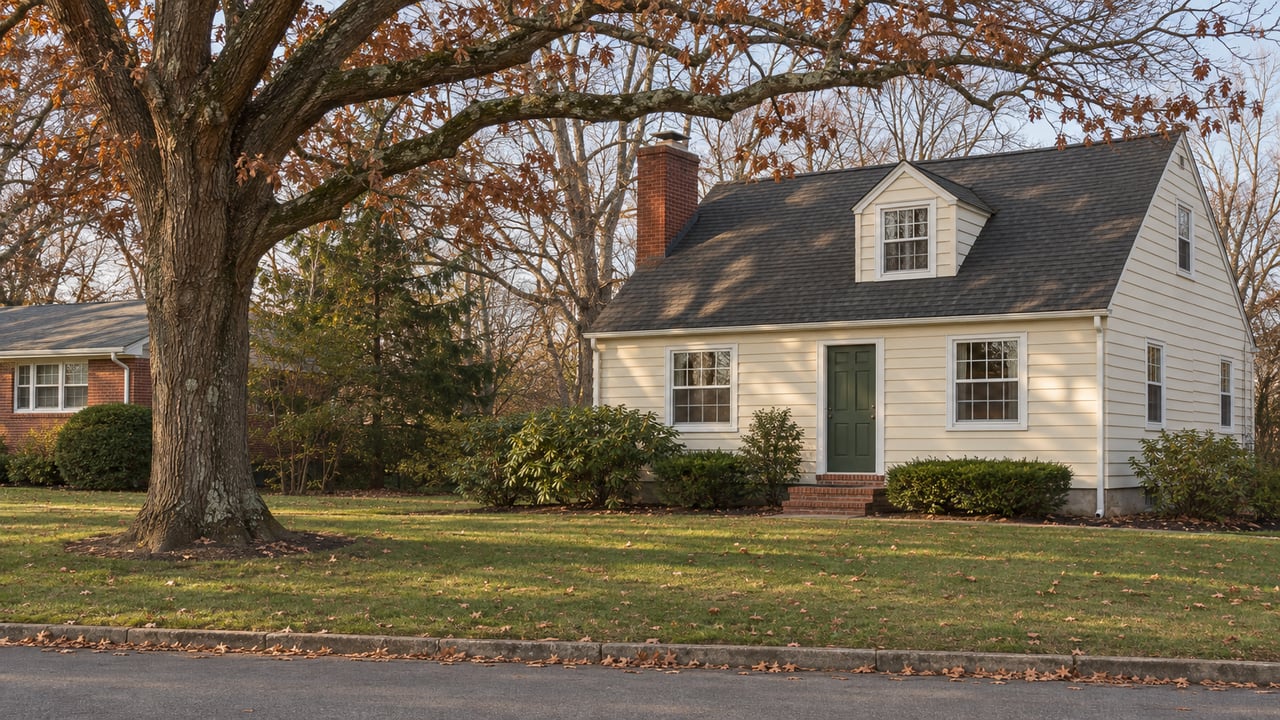
In the last week of October 2026, Mercer County recorded 119 residential property transfers. The middle sale of the whole county was 98 Palmer Lane in Ewing, a 1,373-square-foot home that sold for $380,000. That same week, Ewing also recorded a sale on Pennwood Drive at $99,200 and one on Orchid Lane at $405,000. The gap between those two sales is more than $300,000 in a single week. Ewing was built in rings over about seventy years, and each ring sells in its own price band.
That's the reason a single Ewing median does a poor job of predicting what a particular house will cost. The township grew outward from the Trenton line, and you can still read that growth in what each street's homes sell for. If you're comparing Ewing with neighboring towns, you'll get further by asking which decade a street dates from than by asking what Ewing costs.
Sixty-One Sales, and Eight Above the County Median
NJ.com publishes weekly lists of Mercer County property transfers. Between July 20 and November 9, 2026, six of those lists carried 61 Ewing entries, covering sales recorded from the week of July 6 through the week of October 26. Thirty-four of the 61 sold for between $300,000 and $450,000. Nineteen sold for less than $300,000. The middle entry was $354,000.
Eight of the 61 topped $482,500, the median sale price for single-family homes across Mercer County in October 2026, according to New Jersey Realtors. The weekly lists cover recorded transfers of every residential type, so they mix houses with smaller attached homes. Most of what traded in Ewing this summer and fall sold well below the county's middle price for a house.
The township's own history explains why.
The First Ring, Along the Trenton Line
Ewing's earliest suburbs grew up along its border with Trenton in the early 1900s, once trains and streetcars made commuting practical. The township's history page names Homecrest, Prospect Heights, Prospect Park and Weber Park as those first neighborhoods. The Ewing Green Team dates them precisely: Prospect Heights to 1902, Prospect Park to 1917, Weber Park to 1920 and Homecrest to 1921, followed by Fernwood in 1925. When General Motors built its plant in 1938, Fernwood and Glendale grew with the jobs it brought.
Many of Ewing's lowest recorded prices this season came from this ring. Homecrest Avenue had three entries. Number 289 sold for $183,000 at 1,198 square feet. Number 108 sold for $228,500 at 1,320 square feet, which works out to $173 a square foot. Number 131 sold for $345,000 at 1,624 square feet. All three are on the street that gave the 1921 neighborhood its name, and the spread between them is about $160,000. Size explains part of it, since the priciest of the three is also the largest by more than 300 square feet.
The Green Team's neighborhood map shows Prospect Street as a way into Prospect Heights. At 1615 Prospect Street, a 2,556-square-foot home sold for $381,000 in the week of October 12. That's under $150 a square foot for one of the largest houses in this sample. On Ohio Avenue, three sales recorded between July and early November ran from $165,000 to $252,000. Each house was between 924 and 1,058 square feet.
West Trenton is just as old and has more variety. The Green Team describes it as a mix of detached single-family homes and half-duplexes, most of them built between the early 1900s and the 1950s, centered where Bear Tavern Road and Grand Avenue meet West Upper Ferry Road. In the week of October 12, 525 Grand Avenue sold for $262,000 at 2,818 square feet, about $93 a square foot and the largest house in the six lists. In August, 107 Upper Ferry Road sold for $395,000.
The Postwar Middle, Where Most of the Sales Landed
After World War II, Ewing grew quickly. The township lists Parkway Village, Moss Homes, Wynnwood Manor and Fleetwood Village from that boom, and Hampton Hill, Hillwood Manor, Sherbrooke, Hickory Hills and Village on the Green after it. The Green Team's map describes several of these subdivisions house by house, and the sales on their access streets this season fell between about $440,000 and $550,000.
Hillwood Manor is the best documented. It's a subdivision of detached homes built mostly between 1954 and 1974, and its median house dates to around 1963. The median lot is just under a quarter acre and the median house is about 1,900 square feet. About three-quarters of the homes have full basements, and almost two-thirds have garages. Rockland Road is one of the streets into Hillwood Manor from Bunker Hill Road, and 27 Rockland Road sold for $505,000 in late July. That's $414 a square foot for a 1,220-square-foot house, the highest price per square foot of any sale in this group.
Fleetwood Village is older. Its detached homes went up mostly in the 1940s and 1950s, and Duke Street, off Lower Ferry Road, is one way in. In October, 3 Duke Street sold for $444,000 at 1,368 square feet.
Shabakunk Hills dates from the 1960s. Its homes typically have 1,700 to 2,300 square feet, and you reach the neighborhood from Bull Run Road by way of Metekunk Drive or Malaga Drive. In July, 194 Bull Run Road sold for $551,500 at 1,962 square feet. Hickory Hill Estates and Village on the Green are similar. Both are mostly 1950s and 1960s homes with three or four bedrooms and one- or two-car garages. Village on the Green sits inside the square formed by Charles Ewing Boulevard, Pennington Road, Upper Ferry Road and Lower Ferry Road, and it has its own passive park.
Palmer Lane, where the county's median sale took place in late October, is its own small mapped pocket on the Green Team map. At $277 a square foot, it sits right in the middle of Ewing's price range.
These midcentury houses earn their prices through features the first ring often lacks: a basement, a garage and a quarter-acre lot. A buyer comparing a house on Homecrest Avenue with a 1963 house in Hillwood Manor is comparing two different kinds of house, and the price difference reflects that.
The River and Ridge Edges at the Top
Ewing's highest prices this season came from its northwestern edges, toward the Delaware River and the Hopewell line. Riverview Drive, off Upper Ferry Road West, is one of two ways into Wilburtha. The Delaware and Raritan Canal runs through that neighborhood. In the week of October 12, 11 Riverview Drive sold for $662,000 at 2,464 square feet, the highest price in all six lists. Jacobs Creek Road roughly marks the northern boundary of Mountain View, and 95 Jacobs Creek Road sold for $510,000 in September at 1,316 square feet.
The rest of the top group came from cul-de-sacs and newer-sounding street names. Those were 8 Locke Court at $630,000, 23 Sundew Drive at $580,000 and 14 Mansfield Road at $550,000, each between 1,690 and 2,242 square feet. Measured by price per square foot, the top group isn't far ahead of the postwar middle. Riverview Drive came to about $269 a square foot, close to Palmer Lane's $277. Buyers at the top of Ewing's range are mostly paying for more house and a quieter setting. They aren't paying much more per square foot.
The Newest Ring Is a Rental
The most recent addition to Ewing is Ewing Town Center, built on the former General Motors site, and it's a rental community. Its posted floor plans showed advertised starting rents in August 2026 of $1,695 to $2,425 a month for one-bedroom units, $2,375 to $2,990 for two bedrooms and $2,665 to $3,845 for three bedrooms. Rents there change with availability. For a household deciding whether to rent or buy, those rents are the number to set against a purchase in the $300,000 to $450,000 band where most of this season's Ewing sales landed. The site's mortgage calculator can turn a specific sale price into a monthly payment you can set beside those rents.
The Countywide Backdrop This Fall
The NJ Realtors data shows Mercer County's market loosening a bit heading into winter. In October 2026, single-family inventory across the county was 597 homes, up 12.9% from October 2025. Supply rose to 3.4 months from 2.9. Sellers received 99.8% of list price on average, down from 100.6% a year earlier, and homes took 36 days to sell. In the same October report, townhouse and condo sales had a median of $336,500 and took 44 days, with sellers receiving 98.4% of list.
Read alongside the 61 recorded sales, they suggest a buyer this winter may have a bit more room to negotiate than last fall, and a lower starting price than in most of the county. The street will still decide how much lower. Our Ewing neighborhood page covers more of the township's day-to-day geography. Investors weighing the rental side can start with our first-time investor guide to Ewing.
If you're comparing a house in one of the early neighborhoods near the Trenton line with a 1960s house in Hillwood Manor or a Wilburtha property near the canal, the Terebey Relocation Team can pull the recent sales on those exact streets and help you weigh what each era of house is selling for. If you already own in Ewing and want to see where your street sits in this fall's range, request a free market consultation and home valuation.
